Automatically post blog updates (RSS Auto post)
With "RSS Auto post," you can automatically Post to X (Twitter) when websites or blogs are updated, using RSS feeds. We will explain an overview of the feature, how it works, and important notes.
The number of Post settings, Post acquisition interval, and maximum number of Posts vary depending on your Plan. For details on Plans, please refer to the Plan table.
Overview of RSS Auto post
When you Add RSS Auto post settings, SocialDog periodically checks RSS feeds and Posts to your X Account if new articles are found.
Supported Feed Formats
To use RSS Auto post, the target website must be distributing feeds in the following formats:
- RDF/RSS 1.0
- RSS 2.0
- Atom 0.3 and Atom 1.0
What is an RSS Feed?
An RSS feed is a technology for distributing update information such as the date and Title, and a summary of content, from websites and blogs. Many blog services and news sites support it.

Links to RSS feeds are often provided via an orange icon like this. Not all web pages have a feed URL. This feature cannot be used for websites that do not distribute RSS feeds.
Notes
- If the distribution frequency or number of distributions is too high, it may lead to unfollows.
- Please distribute content that your Followers might find interesting.
- If the same content is continuously Posted, it will not be distributed.
- Data Posted by RSS Auto post will not appear in the Post history of multi-Posts.
Adding RSS Auto post Settings
- Find the RSS feed URL of the website or blog.
- From the left menu, click [Post] → [RSS Auto post].
- Click [Add].
- Enter the setting items.
- Check the [Post content Preview].
- Click [Add].
Only items whose Post time in the RSS feed is after the time the RSS Auto post setting was Added will be added.
RSS Auto post Settings Items
| Item Name | Description |
| Feed URL | Enter the RSS or Atom feed URL starting with https or http. |
| Check frequency | The frequency at which RSS feeds are checked. |
| Max number of Posts per check | The maximum number of Posts per update by RSS Auto post. |
| Max number of Posts per day | The maximum number of Posts per day by RSS Auto post. |
| Post content | You can set the text to Post. If you select [Custom], you can Add characters before and after the article Title's URL or Change the order. |
| Include images | When enabled, images from the article will be Posted. og:image or twitter:image must be specified as an absolute path starting with https. If not specified, the first image contained in the article body will be Posted. |
| Link Analytics parameters | If set, Analytics parameters (e.g., ?utm_source=SocialDog) for access Analytics tools like Google Analytics can be appended to the end of the article URL. |
How to Register RSS Feeds with Japanese in the URL
If the RSS feed URL contains Japanese characters, the following conversions are required:
For Japanese Domains
The domain portion of the URL needs to be Punycode converted.
Punycode conversion and reverse conversion for Japanese JP domain names
Conversion example: socialdog.jp → xn--qcknrz3a9m5bvh.jp
When the URL Contains Japanese Characters Mid-Path
The Japanese portion of the URL needs to be URL-encoded.
URL Encode/Decode Form - TAG index
Conversion example: https://web.social-dog.net/Japanese/ → https://web.social-dog.net/%E6%97%A5%E6%9C%AC%E8%AA%9E/
When the error message "Failed to retrieve RSS feed. Please check if the RSS URL is correct." is displayed
Please check the following:
Is the RSS feed URL registered?
You need to directly enter the RSS feed URL in the [RSS URL] field. This requires the RSS feed URL, not the top page URL of a blog or similar.
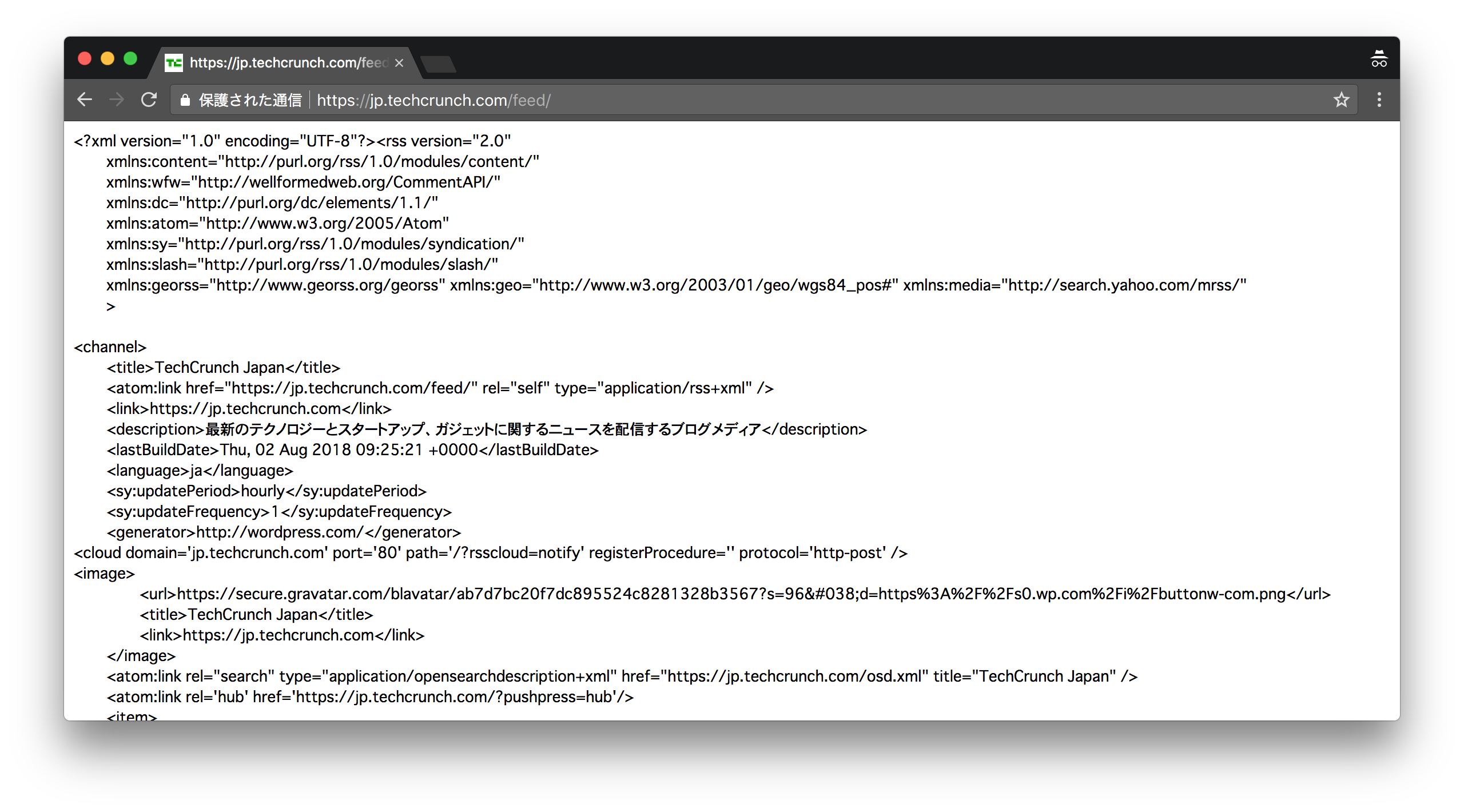
For example, https://jp.techcrunch.com/ is not an RSS feed URL, but the top page URL of a blog. The RSS feed URL for this site is https://jp.techcrunch.com/feed/.
Generally, RSS feed URLs are indicated by a mark like the following:
Clicking this mark displays a file similar to the one below. The appearance may vary. Enter this URL in the [RSS URL] field.
Validate if the RSS feed syntax is correct
If the RSS feed syntax is incorrect, it cannot be retrieved properly. You can check the RSS feed syntax at https://validator.w3.org/feed/.
Deleting RSS Auto post Settings
- Find the RSS feed URL of the website or blog.
- From the left menu, click [Post] → [RSS Auto post].
- Click [Delete] for the setting you want to Delete.
- Click [Delete] again on the confirmation screen.
There is no setting to temporarily stop Posts. If you wish to stop Posts, please Delete the setting. Posts will not be made by RSS Auto post while the setting is Deleted.